

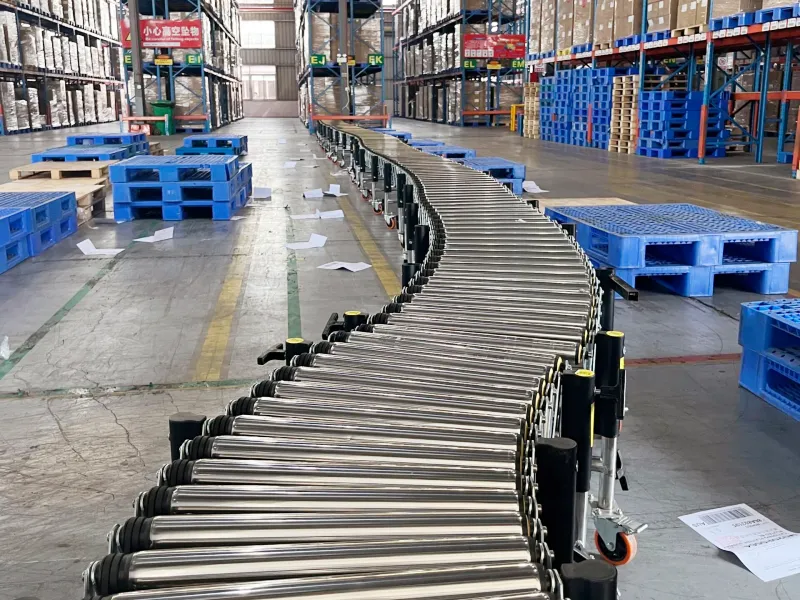
Industrial Flexible Roller Conveyor for Warehouse Material Handling
Modern warehouses operate in a fast-paced environment where efficiency, flexibility, and speed are essential. With the rapid growth of e-commerce, logistics, and distribution industries, companies are constantly searching for material handling solutions that can improve productivity without requiring complex infrastructure.
One piece of equipment that has become increasingly popular in warehouse operations is the industrial flexible roller conveyor. Known for its expandable design and portability, this conveyor system offers an efficient way to move cartons, packages, totes, and lightweight goods throughout a facility.
Unlike traditional fixed conveyors, flexible roller conveyors can extend, retract, and curve to adapt to different layouts and operational needs. This flexibility makes them a practical solution for warehouses that frequently adjust workflows or handle varying volumes of goods.
In this guide, we will explore everything you need to know about industrial flexible roller conveyors, including their working principles, key components, benefits, applications, and how to choose the right system for your warehouse.
What Is an Industrial Flexible Roller Conveyor?
An industrial flexible roller conveyor is a portable conveyor system designed to transport goods using a series of freely rotating rollers mounted on an expandable frame.
The frame typically uses a scissor-style structure, which allows the conveyor to expand and contract like an accordion. This design provides exceptional flexibility, enabling the conveyor to change length and direction depending on the workspace.
Flexible roller conveyors are commonly used for handling:
- Cartons
- Parcels
- Plastic totes
- Boxes
- Bags
- Lightweight package
Most systems operate as gravity conveyors, meaning items move along the rollers by manual pushing or by slight incline. However, powered versions are also available for higher throughput operations.
Because of their simple yet effective design, flexible roller conveyors have become a popular solution in warehouses, distribution centers, and logistics hubs.
Key Components of a Flexible Roller Conveyor System
Although flexible roller conveyors appear simple, they include several important components that ensure smooth and reliable operation.
1. Rollers
Rollers are the primary moving elements of the conveyor. Products are transported along these rotating cylinders.
Common roller materials include:
- Galvanized steel rollers – Durable and widely used in warehouse
- Stainless steel rollers – Ideal for corrosive or hygienic environments
- Aluminum rollers – Lightweight and corrosion resistant
- Plastic rollers – Quiet operation and suitable for lighter loads
Roller diameter and spacing are selected based on the size and weight of the transported items.
2. Expandable Scissor Frame
The expandable frame is what gives the conveyor its flexibility. The accordion-style structure allows the conveyor to extend to longer lengths or compress into a compact form when not in use.
This structure provides both flexibility and structural stability, making the conveyor adaptable to changing warehouse layouts.
3. Adjustable Support Legs
Support legs provide stability to the conveyor and allow height adjustment. Many flexible conveyors include telescopic legs so operators can set the correct incline angle for gravity flow. Adjustable height also helps align the conveyor with other equipment such as packing tables or truck loading docks.
4. Swivel Casters (Wheels)
Flexible conveyors are designed to be mobile. They are usually equipped with heavy-duty swivel casters that allow the system to move easily around the warehouse. Locking mechanisms ensure the conveyor stays securely in position during operation.
5. Side Guides
Side guides or guardrails help keep products centered on the conveyor and prevent cartons from falling off the sides. These guides are particularly useful when transporting irregularly shaped packages.
6. Bearings
Each roller contains bearings that allow smooth rotation. High-quality bearings reduce friction and ensure the conveyor operates efficiently even during continuous use.
How Flexible Roller Conveyors Work
Flexible roller conveyors operate using a simple yet effective principle. Products are placed on the rollers and move along the conveyor through one of the following methods:
1. Gravity Flow
The most common method uses gravity. The conveyor is slightly inclined so products move naturally from the higher end to the lower end.
2. Manual Movement
Operators may push items along the rollers, especially in flat conveyor layouts.
3. Powered Movement
Some flexible conveyor systems use motorized rollers or belt drives to move goods automatically. Because rollers rotate freely, they create minimal resistance, allowing packages to move easily across the conveyor.
Benefits of Flexible Roller Conveyors in Warehouse Operations
Flexible roller conveyors offer many advantages compared with fixed conveyor systems.
1. Exceptional Flexibility
The most obvious benefit is flexibility. The conveyor can be shaped into different configurations such as:
- Straight lines
- Curved paths
- S-shaped layouts
- Circular loops
This adaptability allows the system to work around obstacles or fit into tight spaces.
2. Space Saving Design
When not needed, flexible conveyors can be compressed into a smaller footprint. This is particularly valuable in warehouses where floor space is limited. The ability to retract the conveyor also makes storage easier.
3. Easy Installation and Setup
Traditional conveyor systems often require permanent installation and structural modifications. Flexible roller conveyors, on the other hand, can be deployed quickly without major construction. Operators simply move the conveyor to the desired location and extend it.
4. Improved Warehouse Productivity
By reducing the need for manual carrying of goods, flexible conveyors significantly improve operational efficiency. Workers can move products faster and with less physical effort.
5. Lower Investment Cost
Compared with automated conveyor systems, flexible roller conveyors require much lower capital investment. They offer a cost-effective solution for warehouses seeking to improve material handling without large infrastructure expenses.
6. Mobility and Versatility
Because the conveyors are mounted on wheels, they can be easily relocated to different areas such as:
- Loading docks
- Packing stations
- Sorting zones
- Temporary workstations
This mobility makes them ideal for warehouses with dynamic workflows.
Common Applications in Warehouses and Distribution Centers
Flexible roller conveyors are widely used across many logistics and industrial environments.
1. Truck Loading and Unloading
Flexible conveyors are often used at loading docks to move cartons between trucks and warehouse storage areas. The conveyor can be extended into the truck, reducing the need for workers to carry heavy packages.
2. E-commerce Fulfillment Centers
E-commerce warehouses handle thousands of parcels daily. Flexible conveyors help move packages quickly between picking, packing, and shipping stations.
3. Sorting Operations
Flexible conveyors can be configured to direct packages to different processing areas, supporting sorting operations in distribution centers.
4. Temporary Conveyor Lines
During seasonal peaks or warehouse reconfiguration, flexible conveyors can quickly create temporary conveying lines without permanent installation.
5. Cross-Docking Operations
In cross-docking facilities, flexible conveyors help transfer goods directly from inbound trucks to outbound vehicles.
How to Choose the Right Flexible Roller Conveyor
Selecting the right flexible conveyor system depends on several operational factors.
1. Load Capacity
First, determine the maximum weight of the products being transported. Roller diameter, frame strength, and bearing quality must match the load requirements.
2. Conveyor Width
The conveyor should be wider than the largest package being transported.
Typical widths range from:
- 400 mm
- 500 mm
- 600 mm
- 800 mm
3. Extended Conveyor Length
Flexible conveyors can extend from 3 meters to more than 20 meters depending on the design. Choose a length that fits your warehouse layout and transportation distance.
4. Roller Spacing (Pitch)
Roller spacing should be small enough to support the smallest product. A common rule is to ensure at least three rollers support each package.
5. Frame Material
Industrial environments typically require durable steel frames. Powder-coated or galvanized finishes improve corrosion resistance.
6. Mobility Requirements
If the conveyor needs to move frequently, choose models with strong swivel casters and reliable locking mechanisms.
Maintenance Tips for Flexible Roller Conveyors
Flexible roller conveyors require minimal maintenance, but regular inspections help extend equipment life.
Recommended maintenance practices include:
- Cleaning debris from rollers
- Inspecting roller bearings
- Checking frame joints and bolts
- Ensuring wheels rotate freely
- Lubricating moving parts when necessary
Routine maintenance ensures smooth operation and prevents unexpected downtime.
Future Trends in Flexible Conveyor Systems
Warehouse automation continues to evolve, and flexible conveyors are adapting to these changes.
New designs may include:
- Powered flexible conveyors
- Smart conveyor sensors
- Integrated sorting systems
- Modular conveyor integration
- Automated speed control
These innovations allow flexible conveyors to integrate with modern smart warehouses.
The industrial flexible roller conveyor has become a critical tool in modern warehouse material handling systems. Its expandable design, mobility, and ease of use make it a practical solution for handling cartons, parcels, and lightweight goods.
Compared with traditional fixed conveyors, flexible roller conveyors provide unmatched adaptability. They can extend, retract, curve, and move to different locations as needed, helping warehouses maintain efficient operations even in changing environments.
For warehouses looking to improve productivity while maintaining flexibility and controlling costs, flexible roller conveyors remain one of the most reliable and versatile material handling solutions available today.
Leave Me Your Requirement!